
Admin
Manage every aspect of your school's critical data.
Seamless solutions to help you integrate TASS with your school software ecosystem.
Stay in the loop with the latest updates on school management, education, IT and news from TASS.
Discover TASS with a quick quiz and see how it can help your school.
Explore how we protect your school’s data, including ISO 27001 certification and Australian data residency controls.
Discover how other schools use TASS to keep their operations running smoothly.
Catch up with the TASS team at the upcoming EdTech & school association events.
Reach out and collaborate with your fellow TASS schools.
Take a look at the resources from our 2019, 2023, and 2025 TASScon conferences.

 Across schools, system change is constant. New platforms are introduced, processes are redesigned, and reporting expectations evolve. All of these changes in theory are intended to improve efficiency, but oftentimes, schools find themselves asking the same questions:
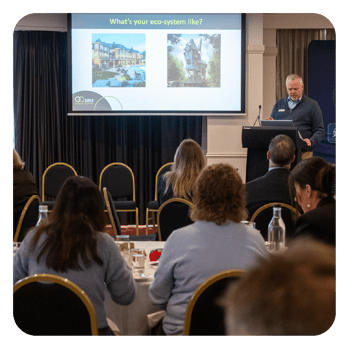
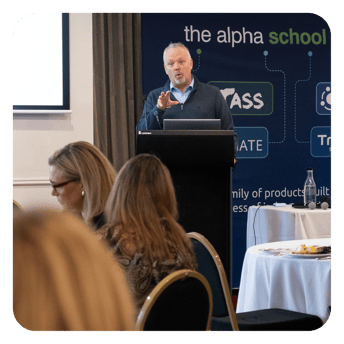
At our recent Roundtable events in Adelaide and Perth, this challenge came into sharp focus, where we were lucky to be joined by Jamie Emswiler, Head of Software and Consultancy at Cole School Experts, who shared his insights and experience in this area.
Here’s where schools may be getting stuck, and how they can move forward.
Most schools haven’t underinvested in technology. It is common to see a system for finance, another for enrolments, something for payroll, HR, learning, wellbeing, and the list goes on. Each of these systems has typically been introduced to solve a specific need or problem at a point in time. While that initial problem can be solved by implementing a new system or solution, over time, the system itself can create further problems.
As Jamie pointed out during his session, most schools end up with an ecosystem that’s been built gradually, with different systems solving different problems, but not always in a way that connects cleanly.
This is where schools may begin to see the same data entered twice or reports that need to be stitched together manually. While none of this is catastrophic on its own, the double-handling of data and the manual workarounds begin to add up.
With schools using a multitude of systems, it’s important to reflect on whether these systems are actually making work easier for your school community.
It’s not uncommon for schools to have heavy investment in technology and software, but still rely on manual workarounds to get things done, staff exporting data into spreadsheets, reformatting reports, and double-checking numbers across platforms just to get a clear answer.
Staff end up spending their time keeping things moving rather than improving how they work. And that’s where the real cost shows up, not just in time, but in missed opportunities to do things better.
There is a tendency to think that if a system isn’t delivering value, the answer is to replace it. In many cases, that might not actually be the issue.
What can develop is a gap between what a system can do and what it’s being used for day to day. Some of the examples Jamie shared really brought this to life. Things like printing reports that already exist digitally or reprocessing invoices manually, despite having tools in place to handle it automatically. While these could be considered basic examples of systems underuse, they are still common in schools and point to a deeper issue: habits haven’t kept pace with capability.
People stick with what they know, especially when they’re busy. If a system feels clunky or if trust has been lost somewhere along the way, they’ll default back to manual processes, even if better options exist.
Another shift that emerged from the discussion was how schools think about their systems in the first place. It’s natural to organise things by function (e.g. finance, enrolments, HR), but that’s not how staff experience them.
People experience processes. For example, a parent enquiry that turns into an enrolment, or a report that needs input from multiple parts of the school before it’s complete.
Organising systems by processes rather than stand-alone functions changes the focus. Instead of asking, “Is this system working?”, you start asking:
Where does this process slow down?
Where are we jumping between tools?
Often, the biggest opportunities lie in those handoffs; for example, improving how systems connect or even simplifying the steps around them can have a bigger impact than introducing something new.
 When it comes to improving systems (or introducing new ones), many schools still take a fairly top-down approach. Decisions get made by leadership or IT, and then rolled out to everyone else.
It’s efficient in the short term, but it can create problems down the track. During his presentation, Jamie highlighted this point pretty directly. One of the most common mistakes he sees is involving too few people, particularly missing the voices of the staff who use these systems every day. When this happens, two things tend to follow:
1. The solution doesn’t quite line up with how people actually work.
2. There’s less ownership over the change, which makes adoption harder.
On the flip side, when schools bring people in earlier, especially admin and operational staff, you get better input and stronger buy-in. You also tend to surface issues sooner, before they turn into bigger frustrations.
Sometimes, all it takes is one person getting on board early to bring others with them.
There is often a temptation to treat system change as something that needs to be big to be worthwhile, such as a full replacement, a major rollout, or a complete overhaul. But that’s not usually how meaningful improvements happen.
Jamie pushed back on this idea with a pretty simple point: you don’t win people over by changing everything overnight; in fact, that’s more likely to cause resistance than progress.
The alternative is much more manageable: start with something small. Fix a process that everyone complains about, automate something repetitive, or clean up one area that’s clearly not working. On its own, it might not feel like a big deal, but when it does something important, it shows that change can make things better.
And once people see that, they’re a lot more open to what comes next.
One final theme that came through strongly was capacity. Even when schools know where the issues are, finding the time and headspace to fix them is another challenge entirely. Teams are already stretched, and system optimisation rarely sits at the top of the priority list.
Jamie challenged the idea that everything needs to be solved internally. In reality, many schools are already comfortable outsourcing certain functions, such as IT support, payroll, or marketing. System optimisation and change support can sit in the same space.
This is where partners like Cole School Experts come into play. Through services like payroll and finance support, operational advisory, and system optimisation, they’re working alongside schools to reduce workload and help teams get more from what they already have, ultimately helping schools thrive.
%20(1).png?width=890&height=267&name=TASS%20Blog%20(1000%20x%20300%20px)%20(1).png)
When you step back, getting more value from your systems isn’t about chasing the next tool or starting from scratch; it’s about making sure what you already have is working the way it should: connecting processes, supporting your staff, and reducing unnecessary efforts across the school.
That said, there does come a point where schools need to ask a bigger question:
Is our current setup helping us move forward, or just helping us get by?
Because if your systems are disconnected, heavily reliant on workarounds, or creating more admin than they remove, then improving processes alone will only take you so far. This is where a more connected approach starts to make a difference.
Systems like TASS are designed to consolidate core functions into a single, unified environment, helping reduce the friction of managing multiple disconnected tools.
As Jamie pointed out in his presentation, the goal isn’t perfection, it’s flow. This is where information flows cleanly across the school, staff don’t have to re-enter or chase data, and processes feel consistent from end to end.
Combined with the right change approach, small improvements, strong adoption, and the right support, this is where schools start to see meaningful change.
/finance-icon-light.png?width=45&name=finance-icon-light.png)
/parents-icon-light.png?width=45&name=parents-icon-light.png)
/Student-icon-light.png?width=45&name=Student-icon-light.png)
/teacher-icon-light.png?width=45&name=teacher-icon-light.png)
/Learning-analyticsicon-light.png?width=45&name=Learning-analyticsicon-light.png)
/Mobile-apps-icon-light.png?width=45&name=Mobile-apps-icon-light.png)
/customer-care-icon-light.png?width=45&name=customer-care-icon-light.png)

/prof-serv-icon-light.png?width=45&name=prof-serv-icon-light.png)
/API-icon-light.png?width=45&name=API-icon-light.png)
/blogs-icon-light.png?width=45&name=blogs-icon-light.png)




/meet-team-icon-light.png?width=45&name=meet-team-icon-light.png)
/history-icon-light.png?width=45&name=history-icon-light.png)
/integration-icon-light.png?width=45&name=integration-icon-light.png)